
 English
 Français
 Italiano
1. Direct lightning strikes
Destructive effects due to extreme impulse currents.
Data Center Plant downtime is extremely costly: prevention is mandatory.
Overvoltages (especially of atmospheric origin) are among the most catastrophic causes of blackouts and data loss. With properly selected SPDs, service continuity, uptime and integrity are ensured.
Because the economic impact of downtime is severe:
Estimated average loss per single event:
≈ 221,400 €
Indicative value based on Ponemon Institute data.
Destructive effects due to extreme impulse currents.
Steep-front overvoltages generating damage with difficult-to-identify origins.
Damage caused by overvoltages originating within the power supply system itself.
Nota:operational continuity is particularly critical for Data Centers (DC), Distributed Control Systems (CEDs), Telecomunications (TLC).
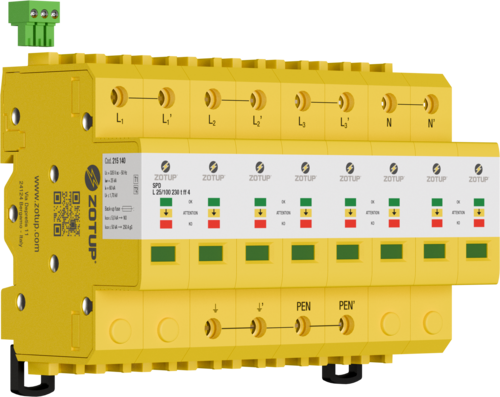 SPD Type 1+2 Three-phase with Neutral Model L 25/100 230 t ff 4 | 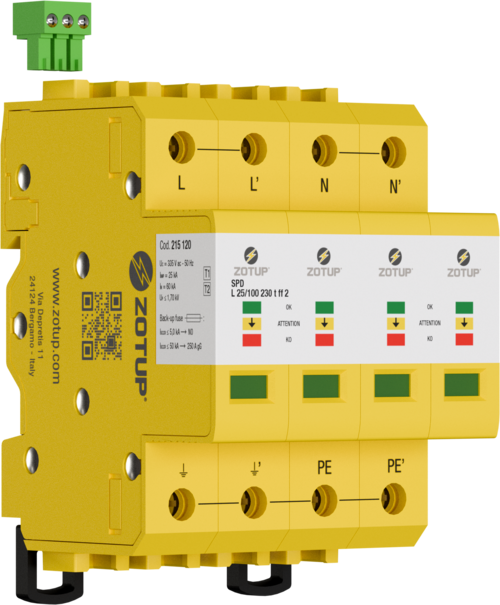 SPD Type 1+2 Mono-phase Model L 25/100 230 t ff 2 |
Objective: intercept impulse currents by discharging them to the ground, protect the equipment, the data and ensure uptime.
Plant survey, network data acquisition, lightning risk level definition.
Identification of correct parameters for selection.
Coordination with internal/external disconnector at SPD end of life. Indication of the correct modality for installing the SPDs
Compliance with IEC 61643-11 Ed.2, certified by internationally recognized markings.
Periodic inspections and guidance for preventive maintenance.
Service continuity and data protection.
Complete and reliable protection.
Local and remote information on SPD efficiency.
Generally yes, if properly sized and positioned. Modern structures are typically reinforced with concrete/steel and therefore do not necessarily require an external LPS.
Assessment must in any case be performed by a qualified expert.
Data Centers typically operate with MV/LV systems due to high loads and dimensions. These systems are nominally equipotential at 50 Hz but rarely so under atmospheric impulses. Lightning impulse current therefore significantly flows into secondary distribution. SPDs must thus all be Type 1+2, with high discharge capacity (Iimp and In) and protection level (Up). Optimal sizing involves replicating the same performance as those installed at the system origin.
Yes. Equipment insulation stress is caused by Upf, which can reach values much higher than Up, even double. Given that electronic equipment impulse withstand level is at least 1500 V, a 750 V protection level is necessary to ensure optimal conditions. Proper cabling measures are also required.
This parameter significantly contributes to making SPDs immune to TOVs in TN and TT systems.
The difference between withstand mode and fail safe mode is that, the withstand mode (the optimal solution) required that SPD under TOV conditions is still “perfectly working”. On the other hand the fail safe mode, in case of some specific TOV conditions, SPD is “damaged” but in a safe manner for the maintenance team and no more to protect system..
Yes. Without energy and voltage coordination, the risk of impulse overload becomes high, leading to damage to both the SPD and protected equipment.
AHUs are typically rooftop-installed and exposed to direct lightning and radiated electromagnetic interference. Their distribution and control panels, also rooftop-mounted, are exposed to extreme conductive pollution (condensation, sometimes salinity). PD3 is essential to ensure installation suitability in such environments.
We support our customers in SPD system design, providing guidance on correct sizing, selection, installation and maintenance criteria.
Click the link below to read recommendations for protecting Data Centers from overvoltages.